



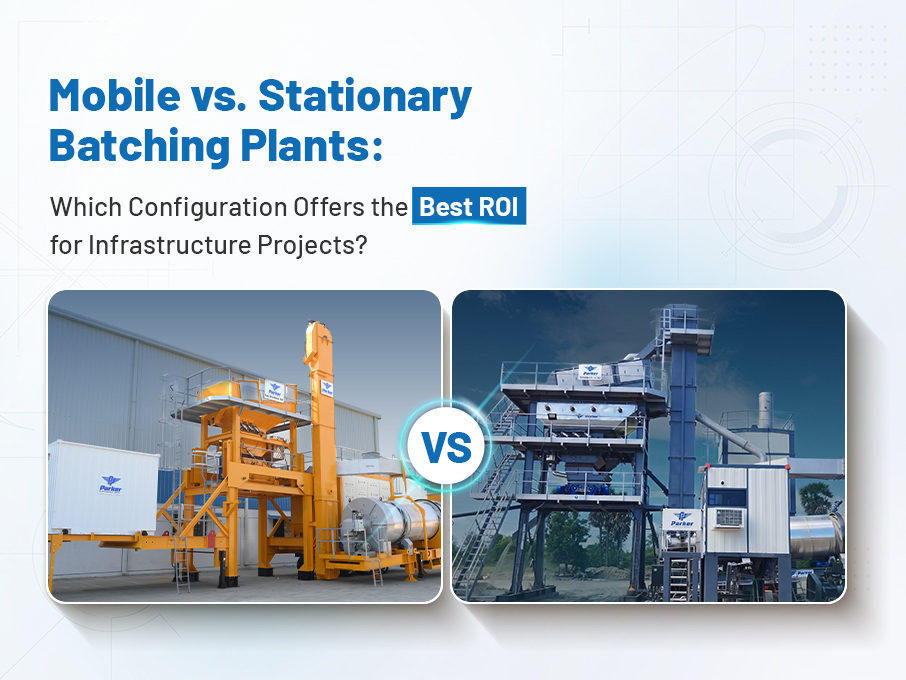
Managing large-scale infrastructure projects requires consistent concrete output, strict construction deadlines, and equipment capable of maintaining reliable production under demanding site conditions. The constant movement of construction fronts, fluctuating material requirements, restricted site access, and pressure to control capital expenditure create a rigorous environment for contractors. Combined with high-volume concrete requirements, project delays, and changing logistics, contractors frequently face production bottlenecks, excessive transportation costs, underutilised equipment, and unpredictable operational downtime.
Parker Plant believes effective concrete production requires tailored engineering. We implement solutions that align plant configuration with project requirements, optimise production capacity, improve equipment utilisation, and protect long-term investment value. This guide outlines how to identify the operational factors that influence batching plant ROI and why selecting between a mobile concrete batching plant and a stationary concrete batching plant should be treated as a project-specific engineering decision.
The Batching Plant ROI Triggers Index
Basic purchase-price comparisons fail to reveal the complete commercial impact of a concrete plant because local project conditions directly influence production efficiency, logistics, and asset utilisation.
| Operational Aggressor | Mechanical / Commercial Impact | ROI-Focused Engineering Solution |
| Moving Construction Fronts | Fixed production locations can increase concrete transportation distances and internal logistics pressure. | Deploys mobile batching systems that can follow changing production requirements. |
| Long-Term Production | Frequent relocation can create unnecessary transport, installation, and recommissioning costs. | Uses stationary configurations where sustained production justifies permanent infrastructure. |
| High Concrete Demand | Insufficient production capacity causes waiting time, delivery pressure, and programme disruption. | Matches plant production capacity with actual peak and average project requirements. |
| Multiple Project Sites | A fixed plant may become underutilised after completion of the original project. | Considers redeployment potential and lifetime asset utilisation. |
Understanding Batching Plant Configuration and Project Efficiency
An unsuitable plant configuration can create a systemic production problem where individual logistical or mechanical inefficiencies affect the entire construction programme. A plant that is too small can create production bottlenecks, while excessive capacity can leave expensive equipment underutilised.
While a simple purchase comparison focuses on equipment price, a true ROI assessment considers the complete operating pathway. A mobile concrete batching plant can reduce the commercial impact of changing work fronts by bringing production closer to demand. A stationary concrete batching plant can provide greater long-term efficiency where production remains concentrated at one location.
Tailored by experienced manufacturers, the correct batching plant configuration helps break the cycle of excessive transportation, avoidable downtime, poor utilisation, and inefficient production. The objective is to create a concrete plant that performs consistently while protecting the contractor’s capital investment.
Step-by-Step Engineering Experience at Parker Plant
Our plant-selection procedure is highly controlled and custom-tailored to the project’s immediate operational requirements.
- Comprehensive Project Assessment (1-2 Hours): We evaluate project duration, expected concrete volume, site access, construction fronts, aggregate availability, utilities, and anticipated production requirements.
- Production Capacity Identification (45 Minutes): We analyse average and peak concrete demand to establish the required production capacity without unnecessarily oversizing the batching plant.
- Configuration Formulation (30 Minutes): We compare mobile and stationary arrangements based on relocation frequency, installation requirements, storage requirements, logistics, and expected equipment utilisation.
- ROI Engineering Protocol (15 Minutes): We assess capital expenditure, operating costs, maintenance, downtime, logistics, redeployment potential, and project duration to identify the most commercially appropriate configuration.
Plant Type & Targeted Application Guide
Different concrete production systems require vastly different engineering approaches to prevent critical investment oversights.
| Machinery Profile | Principal Operational Concern | Tailored Engineering Approach |
| Mobile Concrete Batching Plant | Frequent relocation, changing work fronts, transport requirements, and repeated site setup. | Optimises mobility, setup procedures, material flow, and rapid recommissioning. |
| Stationary Concrete Batching Plant | High sustained production from a fixed location and long-term infrastructure requirements. | Optimises aggregate storage, cement storage, material flow, utilities, and continuous production. |
| High-Production Batching Plant | Excessive production capacity can remain unused when project demand is lower than expected. | Matches production capacity with peak demand while maintaining practical operating headroom. |
| Multi-Project Plant | Equipment may remain idle after completion of a single project. | Prioritises redeployment, utilisation, transport planning, and lifetime asset value. |
Cost Analysis: Mobile vs Stationary Batching Plant
When calculating total project ROI, evaluating total cost of ownership beyond the initial concrete plant price is essential.
| Plant Approach | Average Cost Impact | Required Downtime | Value Rating (ROI) |
| Mobile Concrete Batching Plant | Flexible deployment with potential savings from reduced permanent site infrastructure; relocation costs must be considered. | Minimal / Scheduled | ⭐⭐⭐⭐⭐ (Strong flexibility and redeployment potential) |
| Stationary Concrete Batching Plant | Higher initial site infrastructure commitment but efficient for sustained, high-volume production. | Minimal / Scheduled | ⭐⭐⭐⭐⭐ (Strong long-term production potential) |
| Oversized Batching Plant | Higher capital commitment with increased risk of underutilised production capacity. | Variable | ⭐⭐⭐ (Capacity may remain unused) |
| External Concrete Supply | Lower direct plant investment but continuing supplier, transportation, and delivery costs. | Supplier dependent | ⭐⭐⭐ (Useful where owning a plant is not commercially justified) |
Do You Know?
2026 Infrastructure Pipeline Creates Long-Term Equipment Opportunities
The UK’s March 2026 Infrastructure Pipeline update identifies 734 planned projects covering £718 billion of public and private sector investment over the next decade. The pipeline is intended to provide construction firms and investors with greater visibility for capacity, productivity, skills, and investment planning.
For batching plant operators and infrastructure contractors, this scale of planned work makes equipment utilisation and flexible production strategies increasingly important.
Source: https://www.gov.uk/government/news/infrastructure-pipeline-update-signals-future-workforce-needs
BS EN 206-1:2026 Strengthens the Focus on Controlled Concrete Production
BS EN 206-1:2026 was published on 31 March 2026. The standard applies to concrete used in buildings and civil engineering structures and specifies requirements including concrete constituents, fresh and hardened concrete properties, delivery, production control procedures, and conformity assessment.
For modern batching plant operations, this reinforces the importance of controlled and consistent production rather than relying solely on theoretical plant output.
Source: https://knowledge.bsigroup.com/products/concrete-specification-performance-production-and-conformity-performance-requirements-factory-production-control-and-assessment-criteria-for-individual-values
The Batching Plant Performance & ROI Timeline
● Days 1 – 3: Immediate Site Stabilisation Phase
The selected batching plant configuration is positioned and prepared according to the project’s operational requirements. Mobile systems undergo access and setup verification, while stationary systems undergo installation and infrastructure checks.
Site Care: Confirm site access, foundation or support requirements, electrical connections, water supply, aggregate storage, and safety arrangements before production.
● Days 4 – 10: Production Calibration Phase
Material weighing, batching controls, mix recipes, moisture considerations, and material-flow systems are checked. Production parameters begin to stabilise according to the project’s concrete requirements.
Site Care: Monitor batch consistency and verify that weighing and dosing systems remain correctly calibrated.
● Days 14 – 28: System Normalisation Phase
The concrete plant enters a consistent production cycle. Operators can identify recurring material-flow restrictions, equipment wear, loading delays, and production bottlenecks.
Site Care: Compare actual output with required production capacity and record recurring causes of downtime.
● Months 2 – 6+: Sustained Production Phase
The equipment achieves a balanced operating state. Maintenance intervals, operator routines, material logistics, and production schedules can be refined using actual project performance data.
Site Care: Transition towards a predictive maintenance approach with regular manufacturer inspections and production-performance reviews.
Recommended Daily Preventive Protocol
To safeguard your heavy machinery and maximise batching plant ROI, strictly follow this aftercare routine:
● Controlled Warm-Ups Only: Start machinery according to the manufacturer’s recommended sequence. Avoid immediately demanding full production from cold mechanical and electrical systems.
● The “Post-Shift” Rule for Cleaning: Apply a thorough cleaning protocol after production to remove fresh concrete residue before it hardens around mixing and discharge areas.
● Strict Lubrication Defence: Running mechanical components without appropriate lubrication can accelerate wear. Apply the manufacturer’s recommended lubricant at designated service points.
● Avoid Trauma to Electricals: Prevent water ingress, excessive dust accumulation, and unsuitable environmental exposure around control panels, sensors, and PLC systems.
● Material Flow Inspection: Check aggregate bins, conveyors, hoppers, gates, and discharge areas regularly to prevent blockages from developing into production interruptions.
● Operator Stress Management: Incorporate daily checklist routines. Fatigue, skipped inspections, and incorrect operating sequences can contribute to sudden equipment failures.
Why Choose Parker Plant India Private Limited?
At Parker Plant India Private Limited, we treat concrete production equipment selection as a precise engineering discipline. Every plant recommendation is based on project requirements, expected production, site conditions, and long-term equipment utilisation.
We recognise that a mobile concrete batching plant and a stationary concrete batching plant serve different commercial purposes. Our approach therefore focuses on selecting the configuration that provides the appropriate balance between production capacity, mobility, installation requirements, operating efficiency, and lifetime utilisation.
We ensure bespoke equipment recommendations, adjusting plant configuration based on project duration, concrete demand, site logistics, and expected production cycles. Instead of selecting equipment solely on maximum output, we focus on practical production requirements and long-term profitability.
Our engineering approach helps contractors evaluate the complete investment rather than simply the initial batching plant price.
Frequently Asked Questions (FAQ)
Q1. Which batching plant provides better ROI, mobile or stationary?
ROI depends on project duration, concrete demand, site movement, utilisation, and logistics.
Q2. Is a mobile concrete batching plant suitable for infrastructure projects?
Yes. It is particularly useful where production requirements move between construction fronts.
Q3. When is a stationary concrete batching plant the better option?
It is generally more suitable for long-term, high-volume production from a fixed location.
Q4. Does higher production capacity guarantee better ROI?
No. Excess capacity can remain underutilised and increase capital costs.
Q5. How should batching plant ROI be calculated?
Consider equipment cost, operating costs, maintenance, downtime, logistics, utilisation, and expected asset life.
Conclusion: Your Time for Efficient, Profitable Concrete Production is Now
Navigating demanding infrastructure construction schedules requires an engineering-grade approach that matches plant configuration with actual production requirements. Choosing between a mobile concrete batching plant and a stationary concrete batching plant is not simply a question of which machine produces more concrete; it is a decision about utilisation, logistics, reliability, and long-term investment value.
A mobile configuration can provide significant flexibility where construction fronts move and equipment must be redeployed. A stationary configuration can provide strong long-term efficiency where concrete demand remains concentrated and sufficiently high to justify permanent infrastructure.
Schedule a bespoke technical consultation with Parker Plant India Private Limited, let our engineering experts evaluate your project requirements, and identify the batching plant configuration capable of delivering the consistent, efficient concrete production your infrastructure project demands.
Parker Plant India Private Limited Engineering Team Profile
Every educational guide, technical breakdown, and operational guideline published by Parker Plant India Private Limited is rigorously researched and reviewed with a focus on practical construction-equipment requirements.
From evaluating the impact of project movement on mobile plant utilisation to assessing the production requirements of a stationary concrete plant, our technical content is grounded in engineering principles, current industry requirements, and real-world infrastructure applications.
Our objective is to provide contractors and infrastructure professionals with reliable information that supports confident decisions about batching plant investment, production capacity, equipment utilisation, and long-term project profitability.