



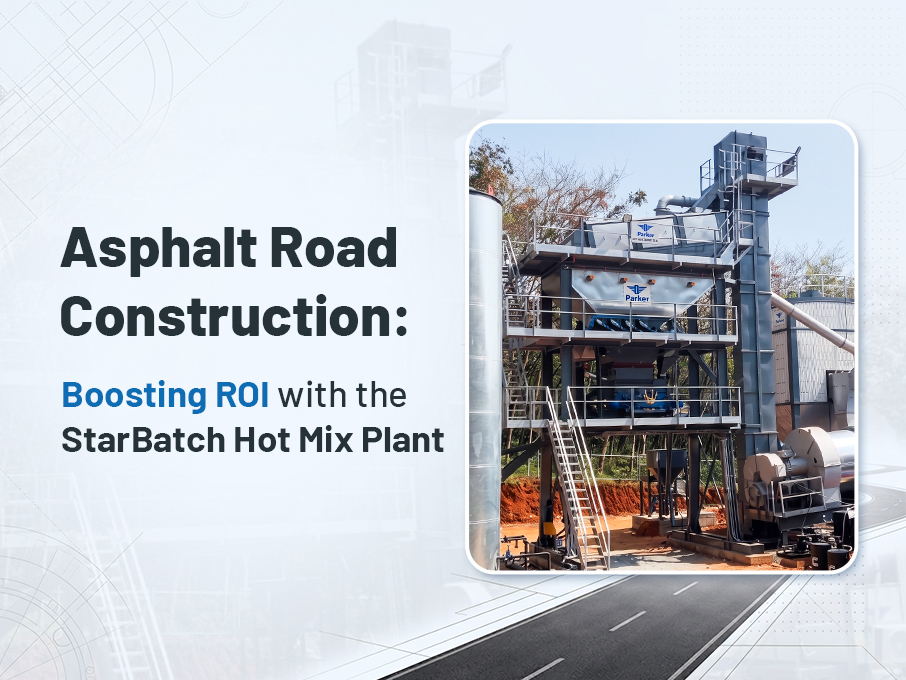
Managing large-scale Asphalt road construction programmes across India is exceptionally demanding. The constant transition between handling abrasive aggregates, maintaining precise bitumen temperatures, and meeting aggressive laying schedules creates a rigorous environment for road-building equipment. Combined with fluctuating material availability, remote project locations, transportation pressures, and strict completion deadlines, contractors frequently face fuel inefficiency, excessive material movement, production bottlenecks, and uncontrollable site downtime.
Parker Plant India Private Limited believes effective asphalt production requires tailored engineering. We implement solutions that improve plant deployment, optimise production efficiency, support consistent asphalt output, and protect long-term project profitability. This guide outlines how contractors can identify the major ROI triggers in Asphalt road construction and why selecting a StarBatch hot mix plant can be a strategic investment for projects requiring reliable production with flexible deployment.
The Asphalt Road Construction ROI Triggers Index
Basic equipment comparisons fail to control persistent project inefficiencies because changing site conditions directly affect the commercial performance of your hot mix plant.
| Operational Aggressor | Production / Commercial Impact | StarBatch Engineering Solution |
| Remote Project Locations | Long transportation distances can increase delivery costs, fuel usage, and scheduling pressure. | Modular plant design supports deployment in remote locations. |
| Short-Term Contracts | Permanent plant infrastructure can create unnecessary installation and recovery costs. | Easy-to-transport, erect, and dismantle StarBatch configuration. |
| High Production Demand | Insufficient output can create paving delays and disrupt continuous laying operations. | 80–200 TPH production range supports different project requirements. |
| Changing Project Locations | Fixed equipment can become underutilised when one contract ends. | Modular design supports relocation and redeployment for future contracts. |
Understanding StarBatch and Asphalt Production Efficiency
An inefficient asphalt production setup is a systemic disruption where equipment limitations can compromise the entire road-construction programme. A poorly positioned hot mix plant increases haulage distances, while inadequate production planning can create interruptions between mixing, transportation, and paving operations.
While contractors searching for hot mix plant price often focus primarily on initial capital expenditure, a true ROI assessment must consider transportation, installation, production utilisation, fuel efficiency, maintenance, relocation, and the expected working life of the equipment.
The StarBatch modular concept is designed to combine transportability and relatively straightforward erection and dismantling with the benefits associated with a traditional tower-style plant. Parker’s current product information lists StarBatch capacities from 80 to 200 TPH and states that the range is designed for both short- and long-term contracts, including remote locations.
Step-by-Step Engineering Experience at Parker Plant India Private Limited
Our plant-selection procedure is highly controlled and custom-tailored to your asphalt project’s immediate operational requirements.
- Comprehensive Technical Assessment (1-2 Hours): We evaluate project length, expected asphalt demand, site accessibility, aggregate availability, haulage distance, contract duration, and required production output.
- Production Trigger Identification (45 Minutes): We analyse expected paving rates, material logistics, working shifts, and site conditions to identify what could drive fuel inefficiency, production delays, or excessive transportation costs.
- Custom Plant Formulation (30 Minutes): We assess the appropriate StarBatch configuration, supporting equipment, storage requirements, material flow, and installation arrangements according to the project application.
- Efficiency ROI Protocol (15 Minutes): We provide a project-specific equipment recommendation and preventive operating routine designed to protect the capital investment and maintain reliable asphalt production.
Plant Type & Targeted Application Guide
Different asphalt production requirements require vastly different engineering approaches to prevent critical oversights.
| Machinery Profile | Principal Operational Concern | Tailored Engineering Approach |
| StarBatch Hot Mix Plant | Transport, erection, dismantling, and production requirements can vary between contracts. | Uses a modular configuration designed for easier transportation and deployment. |
| Remote Asphalt Plant Setup | Limited infrastructure and long material-delivery routes can increase project costs. | Plans plant positioning, material storage, access, and supporting utilities around the project location. |
| High-Demand Road Project | Insufficient asphalt production can interrupt paving operations. | Selects appropriate StarBatch capacity within the available 80–200 TPH range. |
| Multi-Contract Asphalt Plant | Equipment can become underutilised after completion of a single road project. | Uses the plant’s modular characteristics to support relocation and future contract deployment. |
Cost Analysis: StarBatch vs Alternative Hot Mix Plant Approaches
When calculating total project ROI, evaluating the total cost of ownership beyond the initial hot mix plant price is essential.
| Plant Approach | Average Cost Impact | Required Downtime | Value Rating (ROI) |
| StarBatch Modular Plant | Investment includes the plant and supporting infrastructure; mobility can improve redeployment potential. | Minimal / Scheduled | ⭐⭐⭐⭐⭐ (Protects flexibility and future utilisation) |
| Permanent Fixed Plant | Higher site commitment may be justified for long-duration, high-volume production. | Minimal / Scheduled | ⭐⭐⭐⭐ (Strong for stable long-term production) |
| Temporary External Asphalt Supply | Lower direct plant investment but ongoing supplier and transportation costs can increase. | Supplier dependent | ⭐⭐⭐ (Useful where owning production equipment is not justified) |
| Under-Sized Hot Mix Plant | Lower initial investment but potential production bottlenecks during peak paving requirements. | Unpredictable | ⭐⭐ (Can restrict project output) |
Do You Know?
StarBatch Supports 80–200 TPH Asphalt Production
The current Parker Plant product information lists the StarBatch range at 80–200 TPH. Its modular concept is designed to provide contractors with a plant that is easy to transport, erect, and dismantle while supporting asphalt production for both short- and long-term contracts.
This makes production capacity selection an important part of project planning: contractors should match plant capacity with actual paving demand rather than selecting equipment solely on maximum theoretical output.
Source: https://bookstore.asphaltinstitute.org/subjects/hot-mix-asphalt-construction
MoRTH Continues to Update Highway Construction Guidance
The Ministry of Road Transport and Highways continues to publish updated circulars, guidelines and project-related requirements covering India’s highway development and construction activities. Its current resources include guidance on national highway projects, contractor/concessionaire considerations, road design and project implementation.
For contractors, this reinforces the importance of selecting asphalt-production equipment that can support controlled, repeatable output while fitting the practical requirements of individual road projects.
The Asphalt Production & ROI Timeline
● Days 1 – 3: Immediate Stabilisation Phase
The StarBatch plant is positioned according to the project’s production requirements and site logistics. Transport access, plant placement, aggregate storage, power requirements, and supporting infrastructure are checked before full-scale operation.
Site Care: Strictly follow the manufacturer’s erection, commissioning, and start-up procedures to establish stable operating conditions.
● Days 4 – 10: Production Calibration Phase
Material feeding, aggregate flow, bitumen handling, burner operation, temperature control, and asphalt production parameters are progressively checked.
Production output begins to align with the project’s expected paving requirements, while any material-flow or operational restrictions can be identified early.
Site Care: Monitor asphalt temperature, material flow, production consistency, and burner performance throughout the operating shift.
● Days 14 – 28: System Normalisation Phase
The plant enters a stable production cycle. Fuel consumption, material handling, production output, and operator routines can be reviewed against actual project requirements.
Site Care: Maintain strict inspection and lubrication schedules and address minor mechanical issues before they develop into production interruptions.
● Months 2 – 6+: Sustained Production Phase
The equipment achieves a balanced, high-yield operating state. Production routines become established, recurring operational issues are reduced, and plant utilisation can be evaluated against project targets.
Site Care: Transition to a predictive maintenance protocol with regular manufacturer audits and production-performance reviews.
Recommended Daily Preventive Protocol
To safeguard your heavy machinery and maximise asphalt production efficiency, strictly follow this aftercare routine:
● Gentle Warm-Ups Only: Start machinery using the manufacturer’s recommended sequence. Allow systems to reach their appropriate operating conditions before demanding sustained full-load production.
● The “Post-Shift” Rule for Cleaning: Apply a thorough cleaning protocol after production to prevent asphalt residues from hardening around material-contact and discharge areas.
● Strict Lubrication Defence: Inspect designated lubrication points according to the manufacturer’s maintenance schedule. Do not allow preventable friction and wear to develop into major component failures.
● Avoid Trauma to Electricals: Prevent water ingress, excessive dust accumulation, and unsuitable environmental exposure around control panels, sensors, and electrical systems.
● Material Flow Inspection: Check aggregate feeding, conveyors, storage areas, bitumen lines, and discharge systems regularly to identify blockages or irregular material flow.
● Operator Stress Management: Incorporate daily checklist routines. Operator fatigue and skipped inspection steps can contribute to avoidable equipment faults and inconsistent production.
Why Choose Parker Plant India Private Limited?
At Parker Plant India Private Limited, we treat asphalt production as a precise engineering discipline. Every equipment recommendation is assessed according to the project’s production requirements, site conditions, contract duration, and long-term commercial objectives.
The StarBatch is designed around a modular concept that provides contractors with a practical balance between asphalt production and deployment flexibility. Parker Plant’s published specifications identify the range as suitable for remote locations and short- or long-term contracts, with capacities from 80 to 200 TPH.
We focus on more than the initial hot mix plant price. Our approach considers plant positioning, production requirements, material logistics, maintenance, equipment utilisation, and future redeployment.
Instead of searching online for a temporary “hot mix plant near me” when production requirements change, contractors can plan their asphalt production strategy around equipment that is designed with transport and redeployment in mind.
Our engineering approach focuses heavily on application-specific plant selection, operational discipline, and long-term asset utilisation, providing a practical path towards improved ROI in demanding Asphalt road construction.
Frequently Asked Questions (FAQ)
Q1. What is the StarBatch hot mix plant production capacity?
The current Parker listing gives the StarBatch range as 80–200 TPH.
Q2. Is StarBatch suitable for remote asphalt road projects?
Yes. Parker describes the range as suitable for asphalt production in more remote locations.
Q3. What affects hot mix plant price?
Capacity, configuration, supporting equipment, installation, and project requirements can affect the overall investment.
Q4. Can StarBatch be used for short-term contracts?
Yes. The manufacturer describes the range as suitable for both short- and long-term contracts.
Q5. Is a Parker hot mix plant suitable for highway construction?
The appropriate configuration depends on the project’s production, logistics, and technical requirements.
Sources
- https://morth.nic.in/
- https://irc.nic.in/
- https://bookstore.asphaltinstitute.org/subjects/hot-mix-asphalt-construction
- https://www.epa.gov/stationary-sources-air-pollution/asphalt-processing-and-asphalt-roofing-manufacturing-national
Conclusion: Your Time for Efficient, Profitable Asphalt Production is Now
Navigating India’s demanding Asphalt road construction deadlines requires an engineering-grade approach that controls production inefficiencies while protecting the value of your equipment investment. Selecting a hot mix plant based only on its initial price can overlook the financial impact of installation, transportation, production capacity, maintenance, downtime, and future deployment.
The StarBatch modular concept provides contractors with a combination of asphalt production capability and deployment flexibility. With a published capacity range of 80–200 TPH and a design intended to simplify transportation, erection, and dismantling, it can be considered for both short- and long-term contracts where project logistics make modular production commercially relevant.
Schedule a bespoke technical consultation with Parker Plant India Private Limited, let our engineering experts evaluate your asphalt production requirements, and identify the StarBatch configuration capable of supporting consistent, efficient, and commercially sustainable road construction.
Parker Plant India Private Limited Engineering Team Profile
Every educational guide, technical breakdown, and operational guideline published by Parker Plant India Private Limited is rigorously researched and developed around practical asphalt-production and infrastructure requirements.
From evaluating the effect of remote project locations on plant logistics to assessing production capacity, equipment utilisation, and maintenance requirements, our technical content is designed to help contractors make confident decisions about heavy machinery investments.
Our engineering approach combines practical plant considerations with current industry requirements, helping road-construction professionals evaluate equipment not simply by its initial cost, but by its ability to support reliable production and long-term project profitability.